Bonus Fun Fact: There is a total lunar eclipse happening this weekend, on the night of Sunday May 15th into Monday morning. I am usually behind the curve on stellar events but, this time, I was able to give a few days’ warning. Hooray! The penumbral stage will start, in Iowa, around 8:30 pm, with the partial eclipse beginning an hour later around 9:30. Hopefully it won’t be too cloudy and/or raining.
If you are confused on what a ‘penumbral’ is, I’ll explain. Recall that a lunar eclipse is where the Earth comes directly between the Sun and the Moon. The Earth’s shadow will block out the face of the otherwise full Moon, thereby eclipsing it. As the eclipse approaches, there are stages that occur, corresponding to the shadow that is cast. The penumbral stage is the first stage, with a diffuse and partial shadow (penumbra) being cast, followed by the well-defined, direct shadow (umbra) that we often associate with eclipses. When the Moon is totally covered by the umbra, that is what’s called totality, or total eclipse.
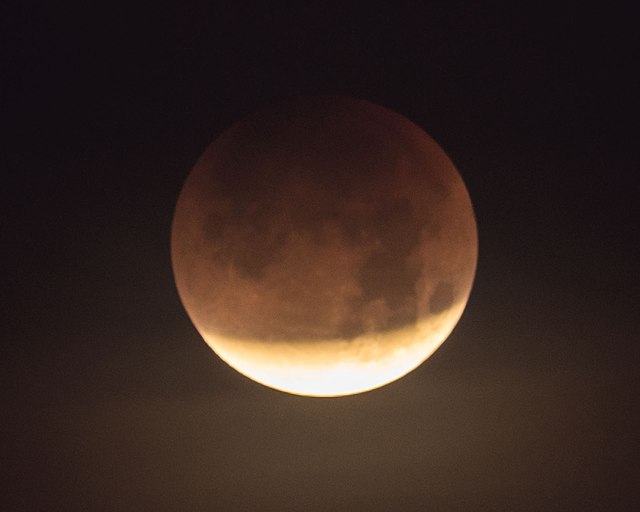
Contrary to common sense, a lunar eclipse is not totally black, but a dark red color. This is caused by the light of the Sun being bent (refracted) through the Earth’s atmosphere. Because light on the red end of the spectrum is more easily refracted than light on the blue end, the red light is able to make it around the Earth to shine on the surface of the Moon, even though the Earth is directly in between it and the Sun. It’s the same thing that causes sunsets to be red. Physics is crazy!
Bonus Bonus Fun Fact: A lunar eclipse is sometimes called a Blood Moon.
Bonus Bonus Bonus Fun Fact: The full Moon of May is also called the Flower Moon.
Does this mean that this lunar eclipse is a Flower Blood Moon? A Blood Moon Flower? You can ponder this while you’re out there viewing it.
 Jason E. Andersen
Leave a comment