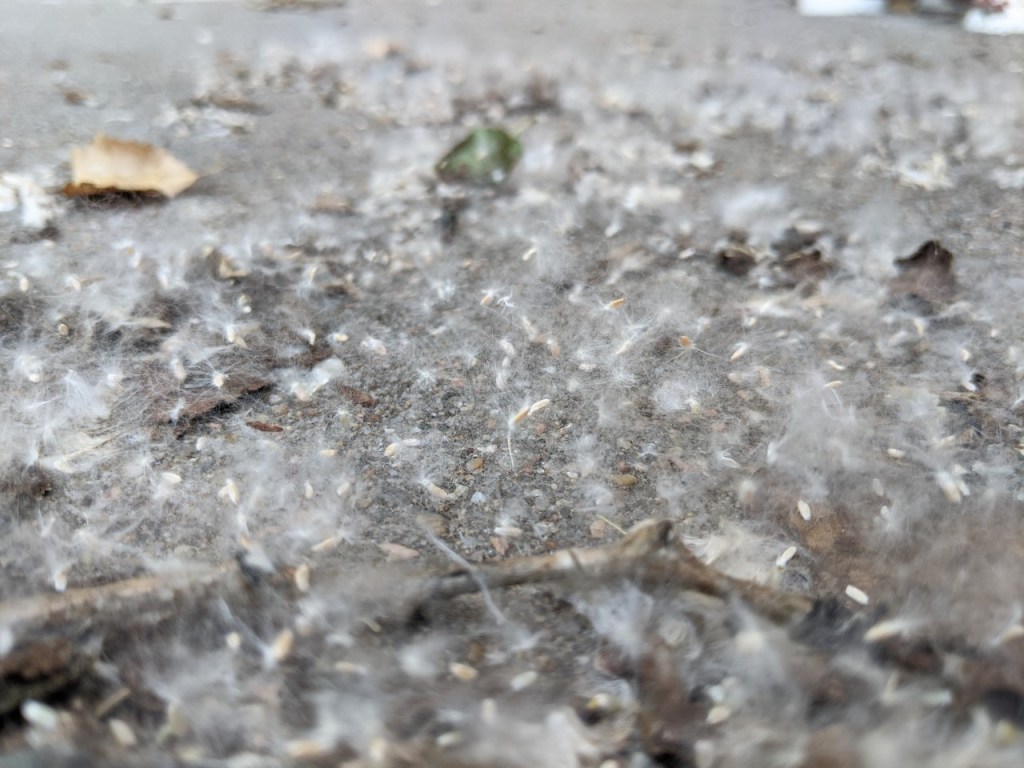
You may have noticed little white fluffs drifting from the sky and settling on your sidewalk, windshield wipers, and/or hair. Really, they can collect anywhere and everywhere. These are cottonwood seeds and each year they create a summertime snowfall.
Cottonwood trees, otherwise known as Eastern poplar or Populus deltoides if you’re a plant nerd, is a fast-growing tree that puts out lots of wind-dispersed seeds. Each little seed has a series of stringy hair-like structures attached to it which catch the wind send the seeds flying. I can’t remember the botanical term for those structures right now but I’m sure there is one.
Bonus Fun Fact: An individual cottonwood tree can produce more than 25 million seeds. These seeds drift around the landscape and readily germinate in moist soils where they are best adapted. I’m always amazed at the sheer numbers that nature puts out. To maybe put it some semblance of perspective, the population of the state of Iowa is right around 3.2 million. So each cottonwood tree can put out almost 8 times as many seeds as there are Iowans in the state. I don’t know why I drew that parallel, but I did.
Bonus Bonus Fun Fact: Cottonwoods tree individuals have distinct sexes. That is to say, there are male and female trees. Biologists call this dioecious, because there has to be a term for everything. Therefore, only the female plants produce the seeds and the associated fluff. The male trees just stand there and give off pollen.
Bonus Bonus Bonus Fun Fact: The largest recorded cottonwood tree is the Frimley Park tree, located in Hastings, New Zealand. It measures 138 feet tall, 33.4 feet of girth (circumference), and 10.6 feet diameter. That’s a lot of tree. You can view more details on this beast on the New Zealand Tree Register.
 Jason E. Andersen
Leave a comment