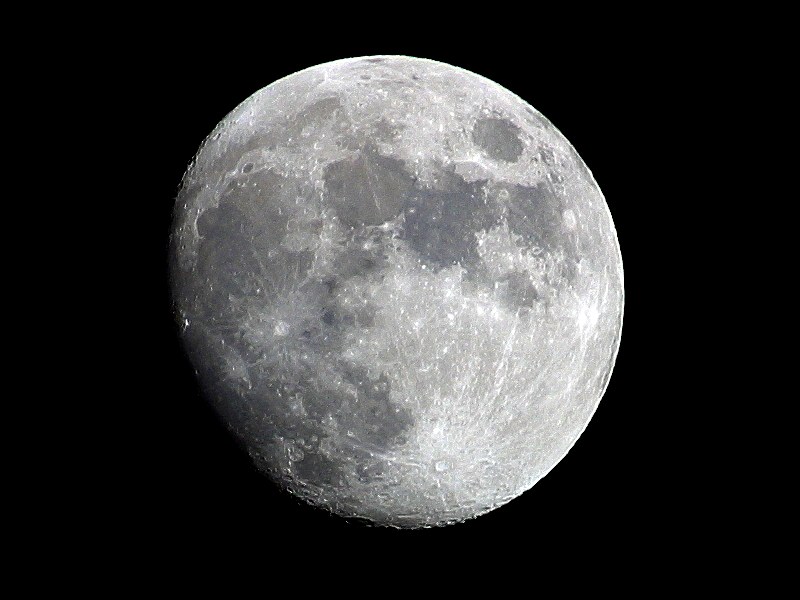
I assume you are familiar with the Moon. It is the celestial companion to the Earth, spinning around us in a never-ending dance.
Or is it?
Bonus Fun Fact: Every year, the Moon travels about one and a half inches farther away from the Earth. The Moon orbits the Earth mostly due to Earth’s gravitational pull. However, the Moon also exerts gravitational force on the Earth. The Moon’s gravity pulls on the Earth, causing the water of the oceans to pull towards the Moon, creating the rise and fall that we know as tides. It’s this gravitational interaction that causes the Moon to slowly dance away into the black.
This is where the magic of physics comes into play, and I don’t pretend to fully understand it. The Earth is spinning and exerting its gravitational force on the Moon, the Moon is pulling back and dragging the oceans against the Earth’s spin, the Moon itself is not spinning, but it is orbiting in a funky wobble around the Earth — there are a lot of factors that are going into it. At the end though, some of the energy of all this motion is transferred to the Moon, pushing it into a slightly higher orbit and farther away from the Earth, at about the rate your fingernails grow.
Don’t worry though, scientists also think that, in about 50 billion years or so, the Moon will settle into a more stable orbit, so the Moon won’t be sailing away into space never to be seen again. However, by that time we will have much bigger problems. In only about 5 billion years, the Sun will have entered into its red giant phase. At that point, the Sun will swell to about 256 times its current size, engulfing the planets of Mercury and Venus, and being right at the doorstep of Earth. The Earth itself will be cooked to a rocky husk, if not being outright destroyed, along with the Moon.
 Jason E. Andersen
Leave a comment