Having a poison ivy rash is like being in an itchy red hell. The key to avoiding this is to be able to identify the plant and steer clear. Because I care about your well-being, and want you to be able to enjoy the outdoors this growing season, here is a guide on how to identify this oily evil.
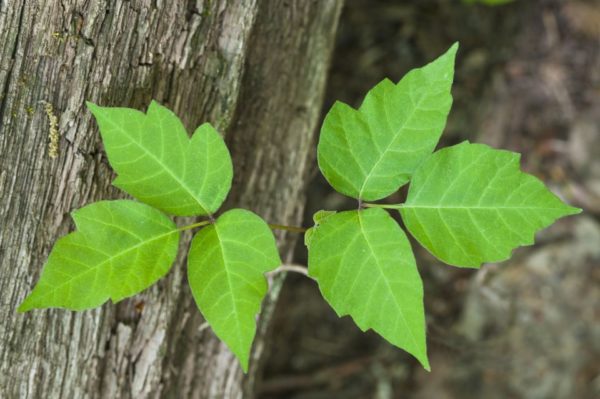
Bonus Fun Fact: There are three characters you need to remember to positively identify poison ivy:
1) It has three leaflets with smooth margins.
Poison ivy has a compound leaf that is composed of three leaflets. The leaflets are arranged with one central leaflet at the point, flanked by two more leaflets on the sides.
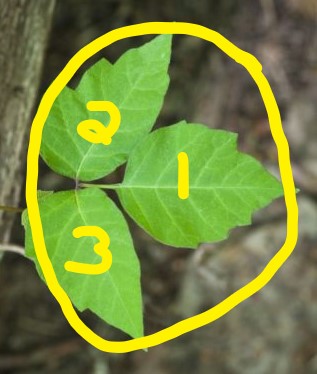
The popular saying “leaves of three, let it be” holds true in this regard, but it only gives part of the picture. In fact, several common plants also exhibit this character. While avoiding all three-leaved plants is certainly an option, you can look a little harder and make things easier for yourself.
Also notice that, aside from the pointy lobes, the leaf edge (called a margin) is quite smooth and toothless. Being able to recognize this little character will come in handy.
2) The stem of the central leaflet is longer than on the other two leaflets.
The three leaflets each have a little stem (called a petiolule) connecting the leaflet to the main stem of the plant. On poison ivy, the petiolule of the central leaf is quite long, while the petiolules of the side leaflets are short, with the leaflet almost being connected to the main stem itself.
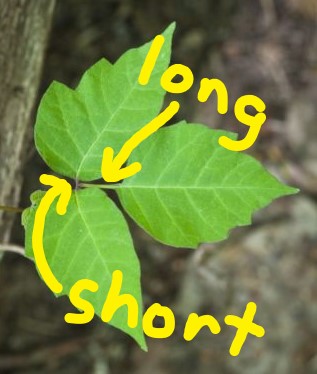
While this might seem insignificant, and kind of nerdy, this is actually a very good character to separate poison ivy from other plants. Once you get some practice recognizing it, you’ll find it’ll serve you well, especially when you combine it with the next character.
3) The flanking leaflets are asymmetrical.
While the central leaflet of poison ivy is symmetric (that is, both sides appear as mirror images of each other), the flanking leaflets are asymmetric, with one half of the leaflet being larger than the other. Often, but not always, this manifests as a lobe jutting off to one side of the leaflet. This gives the easy-to-remember appearance of an oven mitt, where the jutting lobe of the leaf is the thumb.
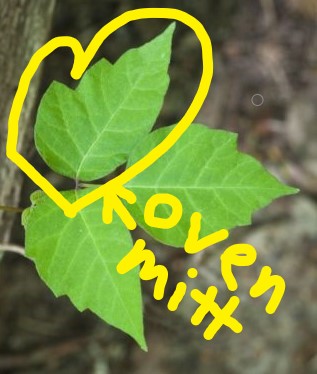
Just keep in mind that the oven mitt appearance isn’t always there, but the asymmetry is. One half of the leaflet will always be bigger than the other.
By the way, poison ivy can grow either on the ground as a little herbaceous plant, or as a vine, climbing up into trees and attacking you from above. However, in either growth form, the leaves will have the same characters.
Okay, let’s practice. Below is a common sight when walking through an Iowa woodland during the summer. Can you find the poison ivy?
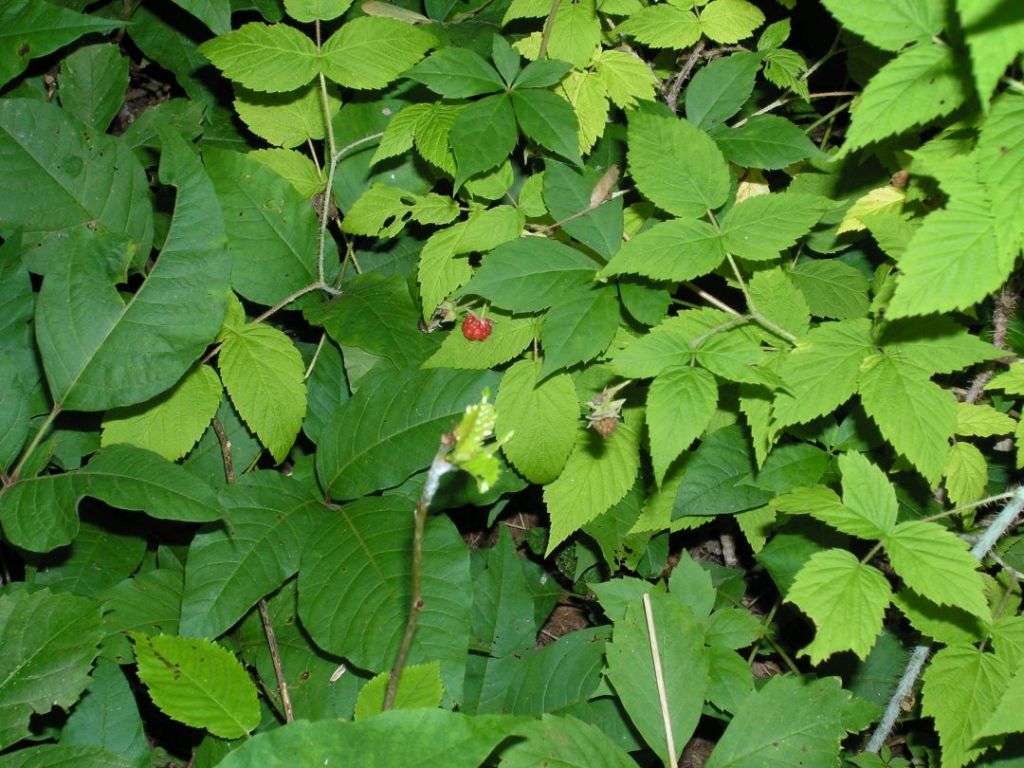
If you follow the leaves of three, let it be rule, walking through this patch of foliage would probably not be an option. Plant species such as Virginia creeper, hog peanut, wild raspberry, and others, often look very much like poison ivy, especially to the casual observer. But you are no casual observer! You are an educated amateur botanist now!
If you are the immediate gratification type, below are the answers.
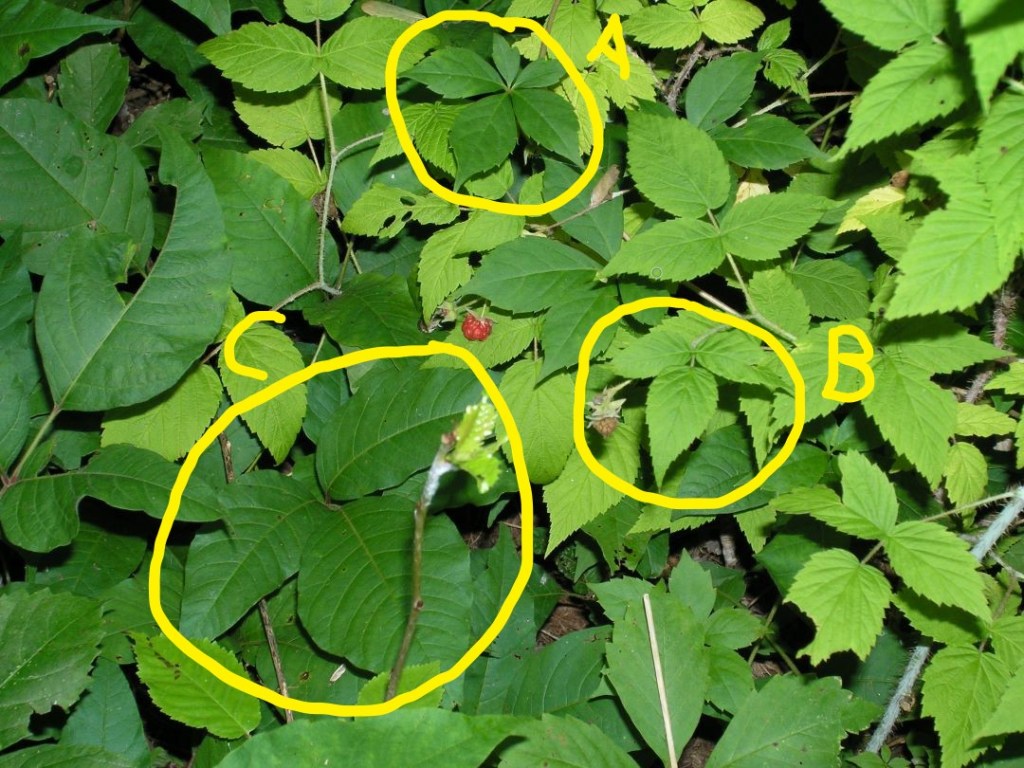
A) Virginia creeper – A common look-alike, Virginia creeper actually has five leaflets, with the two rear-most leaflets being quite smaller than the other three. If you happen to miss the two smaller leaflets, or if they’re absent altogether, you might confuse it with poison ivy due to the leaves of three rule. Also, the petiolules of Virgina creeper are all equal in length.
B) Wild raspberry – The toothed margins of wild raspberry should be an immediate giveaway that this is not poison ivy.
C) Poison ivy – The real thing! Most notable in this picture is the lack of the oven mitt appearance, but the asymmetry is there, as are the leaflet petiolule length difference and smooth margins. Steer clear!
You are now a graduate of the School of the Red Rash! Hopefully your education will help you stay out of danger during your summer adventures.
 Jason E. Andersen
Leave a comment